




Tanzania’s $1trn dream facing 2058–2062 delay, TICGL warns
Tanzania’s ambition to build a $1 trillion (2,600trn/-) economy by 2050 under the Dira 2050 framework is likely to be achieved later than planned, with a new policy research analysis projecting the milestone will fall between 2058 and 2062 if current trends continue.
The report by economic consulting group-TICGL, released late last month, says that at the current real GDP growth rate of 5.9 percent, Tanzania would only reach the trillion-dollar level around 2065 unless major structural reforms are implemented to accelerate growth.
According to the analysis, Tanzania’s economy stood at about $91.8 billion in 2025, meaning it must expand more than tenfold to meet the 2050 target.
TICGL warns that achieving this goal would require a sustained growth rate of about 10.2 percent annually, almost double the current performance.
The report states that Tanzania is not facing a failure of vision but rather a gap in execution speed, where policy and structural reforms have not kept pace with ambition.
The study highlights several macroeconomic constraints that continue to slow progress. The economy is currently growing at 5.9 percent, below the required trajectory.
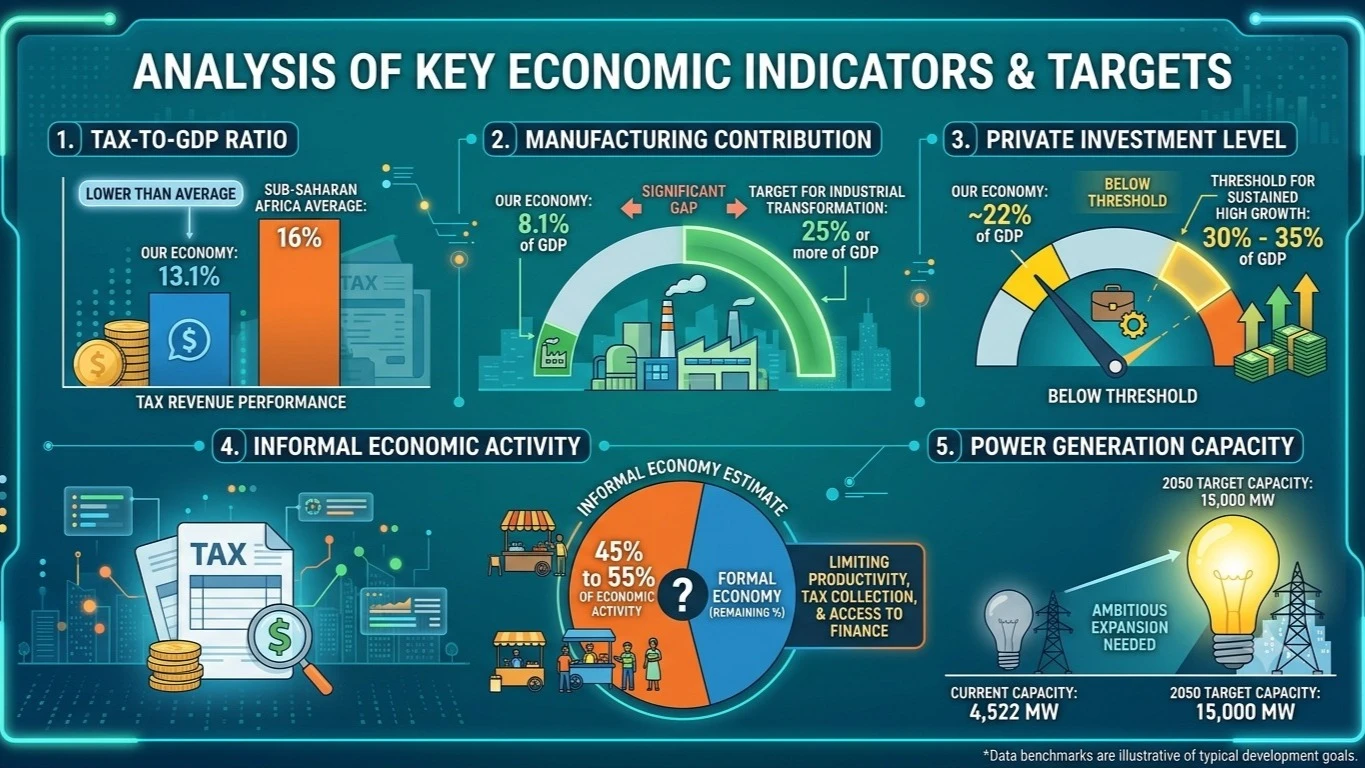
The tax-to-GDP ratio stands at 13.1 percent, lower than the Sub-Saharan Africa average of 16 percent, while manufacturing contributes only 8.1 percent of GDP compared to the 25 percent or more needed for industrial transformation.
Private investment remains around 22 percent of GDP, below the 30 percent to 35 percent threshold considered necessary for sustained high growth.
At the same time, between 45 percent and 55 percent of economic activity is still informal, limiting productivity, tax collection, and access to finance. Power generation capacity stands at 4,522 MW against a target of 15,000 MW by 2050.
TICGL identifies six structural policy gaps that explain the slower growth trajectory. The first is a narrow tax base, where revenue collection is concentrated in the formal sector, leaving the large informal economy largely untapped.
The second is weak industrialisation, with manufacturing still contributing only 8.1 percent of GDP, far below the level required for a modern industrial economy.
The third is private sector crowding-out, where government domestic borrowing reduces the availability of credit for businesses and keeps lending costs high, limiting private investment.
The fourth challenge is the large informal economy, which excludes millions of workers and enterprises from formal financial systems, pensions, and credit access.
The fifth is fiscal imbalance, reflected in a rising wage bill that increased by 31.4 percent in the 2026/27 fiscal year while development expenditure declined, reducing the government’s capacity to invest in long-term productive infrastructure.
The sixth is a human capital mismatch, where the education system is not producing enough technical and industrial skills required for a modern, diversified economy.
The FY2026/27 national budget, valued at 62.33trn/-, shows partial progress in addressing these challenges. The report notes improvements in digital payment systems, increased funding for education, and continued investment in infrastructure such as energy and transport.
However, it also highlights critical gaps, including the absence of any public-private partnership project reaching financial close, a sharply rising wage bill, and a stagnant manufacturing share of GDP.
TICGL concludes that while the government is increasingly acting as an enabler through digital reforms, it still remains the dominant economic actor, limiting private sector expansion.
The report presents multiple growth scenarios. Under the current trajectory of 5.9 percent growth, Tanzania would reach $1 trillion around 2065. With moderate reforms lifting growth to between 7 percent and 7.5 percent, the milestone could be achieved between 2058 and 2062.
Strong reforms pushing growth to 8 percent could bring the target forward to 2054–2056, while achieving the full Dira 2050 requirement of 10.2 percent growth would meet the target on time in 2050. TICGL’s central estimate places the country on a 2058–2062 path based on partial reform implementation.
The analysis also notes that population growth is not a constraint. Tanzania’s population is expected to reach about 130 million by 2050, and at a $1 trillion economy, per capita income would rise to about $7,692, above the Dira 2050 target of $7,000.
The report argues that the key challenge is not demographic pressure but the pace of economic expansion, noting that every additional percentage point of growth could advance the $1 trillion milestone by two to three years.
TICGL concludes that Dira 2050 remains a realistic and structurally sound vision, but warns that without faster implementation of reforms in taxation, industrialisation, private sector development, and skills training, Tanzania is more likely to achieve its $1 trillion ambition nearly a decade later than planned.
Top Headlines
Trending Stories











© 2026 IPPMEDIA.COM. ALL RIGHTS RESERVED