




First-time visitors dominate tourism market during 2025
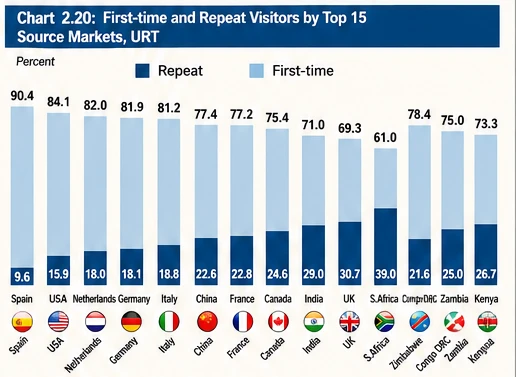
Tanzania Mainland and Zanzibar continue to attract a higher proportion of first-time visitors compared to repeat travellers, though with distinct structural differences between the two destinations, the 2025 International Visitors Exit Survey has shown.
According to the report, Zanzibar recorded a particularly strong dominance of new arrivals, with over 78 percent of total visitors being first-time tourists.
This pattern has remained consistent since 2023, underscoring the island’s continued appeal as an emerging global leisure destination and the success of international marketing campaigns targeting new source markets.
United Republic of Tanzania, by contrast, maintained a more balanced composition of visitors, with a relatively closer split between first-time and repeat travellers, indicating a more diversified tourism base that combines both discovery and return travel behaviour.
Across both markets, first-time visitors overwhelmingly preferred package tour arrangements. This preference is attributed to the convenience, simplicity, and perceived reliability of packaged travel services, which typically include accommodation, transport, and guided itineraries.
Repeat visitors, on the other hand, showed a clear preference for non-package arrangements, reflecting their greater familiarity with destinations and desire for flexibility in budgeting, accommodation choices, and travel schedules.
The survey highlights a clear geographical segmentation in visitor origins. First-time visitors were largely drawn from long-haul markets, including Spain, the United States, the Netherlands, Germany, and Italy.
This trend reflects increasing international visibility of Tanzania’s tourism products, supported by destination branding and improved connectivity. In contrast, repeat visitors were predominantly from neighbouring and regional markets such as Kenya, Zambia, the Democratic Republic of Congo, and Zimbabwe.
This pattern is strongly linked to geographical proximity, easier cross-border mobility, lower travel costs, and deep-rooted cultural and social connections that encourage frequent visits.
In terms of purpose of visit, leisure and holiday travel remained the dominant driver for both first-time and repeat visitors across URT and Zanzibar.
However, a more nuanced pattern emerges in URT, where repeat visitors exhibited diversified travel motivations. These included business travel, visiting friends and relatives (VFR), as well as attendance at meetings and conferences.
This diversification reflects URT’s broader economic structure, administrative functions, and its role as a regional trade and business hub. Zanzibar, by contrast, remained highly concentrated as a leisure-oriented destination, with both first-time and repeat visitors primarily travelling for holiday purposes.
Market-specific analysis shows that first-time visitors to Zanzibar were mainly from Greece, Spain, Poland, the Netherlands, and Germany. Repeat visitors were largely concentrated in Kenya and Australia, indicating both regional and selected long-haul loyalty markets.
Travel behaviour patterns further reveal important insights. In URT, the largest proportion of visitors travelled alone (35.4 percent), followed by those travelling with a spouse (27.1 percent).
Smaller shares travelled with friends or relatives (12.2 percent), with spouse and children (11.6 percent), with parents (7.1 percent), and with children alone (6.5 percent). These figures suggest that solo travel and couple-based travel remain the dominant modes of tourism participation.
Over time, the survey indicates evolving travel party dynamics between 2022 and 2025. Travelling alone and travelling with a spouse consistently remained the most common arrangements in URT, except for a temporary shift in 2024.
In Zanzibar, travel with a spouse consistently recorded the highest share throughout the period, reinforcing its positioning as a romantic and leisure-focused destination.
Notably, travel with friends or relatives declined significantly in 2025 across both regions, suggesting a gradual shift toward more individualised and family-centred travel experiences, particularly couples’ travel.
Overall, the findings point to a growing dual structure in Tanzania’s tourism market: strong international attraction driven by first-time long-haul visitors, and a stable regional base of repeat travellers, complemented by evolving preferences toward flexible, couple-oriented and experience-driven tourism.
Top Headlines
Trending Stories























© 2026 IPPMEDIA.COM. ALL RIGHTS RESERVED