




Agroecology shift: Pathway to climate- resilient and inclusive food systems in Tanzania and East African region
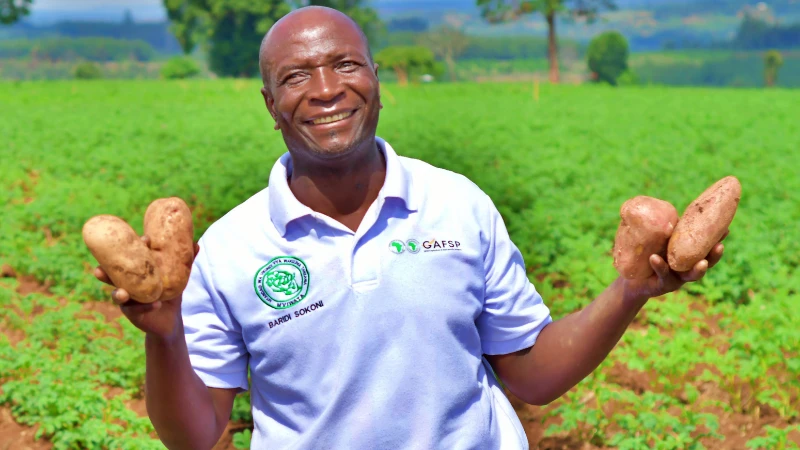
Farmers achieved 25 percent-40 percent yield increase in horticulture while building resilience to droughts and erratic rainfall by managing soil health through mulching, recycling, composting and diversified farming systems under the Food Systems Supply Services in Rural Tanzania (F3SRT) Project (2024–2027), popularly known as Baridi Sokoni project.
Under the Baridi Sokoni project, Irish potato farmers increased market prices from 13,000/- per kilogramme (USD 5/kg) to 20,000 per kilogramme (USD 8/kg) while significantly reducing production costs through the use of organic and locally available inputs instead of expensive synthetic chemicals.
The Baridi Sokoni is implemented by MVIWATA with USD 5.35 million support from the Global Agriculture and Food Security Program (GAFSP) under the supervision of the African Development Bank.
Operating in Morogoro, Njombe, Kilimanjaro, and Zanzibar the project targets 10,000 farmers (65 percent women) through agroecological production, cold-chain infrastructure, and market development interventions.
This project has been of wider impact as potato productivity increased from 8-10 tons/ha to 12-14 tons/ha. It has enhanced climate resilience through soil moisture retention (Mulching) and diversified farming systems, and strengthened women's economic autonomy and household decision-making power.
Implemented in Tanzania and Burundi the project has significantly contributed to scaling up agroecology in the region.
By January 2026, 289 producers (61 percent women) had received direct support, with the project progressing towards its target of 10,000 farmers.
Menard Nziku, a smallholder farmer leader and Chairperson of the Nganda Cooperative Union in Wangingombe District, Njombe region said that during this harvest season the union doubled productivity of irish potatoes with technical support and training offered under the project.
“This project demonstrates that agroecology is a practical and climate-resilient pathway for transforming food systems. By combining ecological farming practices, local knowledge, and collective action, our union improved productivity hence livelihoods, with notable gains in income,” said Nziku.
Idaya Mwalongo, another smallholder farmer in Njombe reported higher profits, enabling her investments in children education and livestock keeping.
Joe Mzinga, ESAFF Regional Coordinator, the Eastern and Southern Africa Small Scale Farmers Forum said that the positive outcomes observed in Burundi and Tanzania demonstrates the transformative potential of GAFSP investments when they reach farmers and their organizations.
According to him, these investments have strengthened food security, climate resilience, livelihoods and the capacity of producer organizations to deliver sustainable development outcomes.
“To achieve broader and more lasting impact across the continent, development partners should increase support for regional funding windows that empower producer organizations to lead, implement and scale solutions tailored to local realities, while fostering cross-border learning, innovation and the scaling of successful farmer-led solutions across Eastern and Southern Africa,” said Mzinga.
Agriculture remains a cornerstone of Tanzania’s economy, employing over 65 percent of the labour force and contributing approximately 27 percent of national GDP.
A 2025 FAO TAPE assessment in Africa found that agroecological practices increased household incomes while strengthening environmental and social outcomes, as demonstrated by the Baridi Sokoni project through agroecological production, cold chain development, and improved market systems.
Across East Africa, the sector accounts for about 35 percent of regional GDP and is dominated by smallholder farmers, who manage more than 80 percent of farms, making their resilience critical for food security, livelihoods, and economic development.
Despite its importance, the sector faces growing and interconnected challenges, including climate change, land degradation, declining soil fertility, biodiversity loss, rising production costs and volatile markets.
Agroecology provides an alternative pathway that integrates ecological principles, local knowledge systems, farmer participation and social justice into agricultural production systems. Rather than focusing solely on productivity, agroecology emphasizes resilience, biodiversity conservation, sustainability, and equity and community empowerment.
Agroecology ensures nutrition security and food sovereignty: Diversified farming systems integrating vegetables, legumes, spices and trees strengthen household food security, dietary diversity and farmer control over seeds and production systems.
Agroecology qualifies for National Determined Contributions (NDC) 3.0 implementation funds, Green Climate Fund resources, adaptation finance and Support towards operationalization of the SADC Regional Agricultural Policy (STOSAR II) €10million funding but must be positioned in national climate strategies and agricultural investment plans.
State policy interventions and financing are essential to support and promote agroecology.
Extension services must integrate agroecology modules, Tanzania National Ecological Organic Agriculture Strategy (NEOAS) 2023-2030 requires accelerated implementation and institutional coordination between Tanzania Official Seed Certification Institute (TOSCI), Agriculture Seed Agency (ASA) and farmer organizations like MVIWATA must be strengthened.
The implementation of the Tanzania Agriculture Master Plan (TAMP) 2050, National Ecological Organic Agriculture Strategy (NEOAS 2023–2030), SADC Support Towards the Operationalization of the SADC Regional Agricultural Policy (STOSAR II) project, the renewal of the Regional Agri-Food Systems Investment Plan (EAC RASIP0 and the CAADP Kampala Declaration (2026–2035) presents an unprecedented opportunity to institutionalize agroecology at national, regional, and continental levels.
Together, these frameworks provide strategic entry points for integrating agroecology into agricultural investments, extension services, climate action, research, and food systems transformation agendas.
Top Headlines
Trending Stories














© 2026 IPPMEDIA.COM. ALL RIGHTS RESERVED